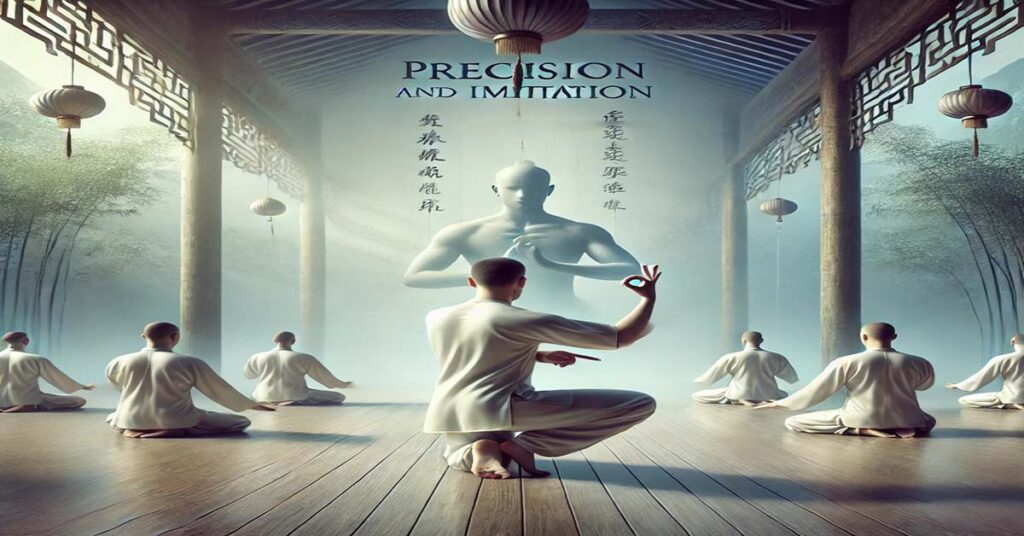
In the world of internal martial arts, where subtlety and precision can mean the difference between mastery and mediocrity, the lessons taught by Master Steve Gray carry weight far beyond the movements themselves. His teachings on the critical importance of precise imitation, particularly in the realm of Nei Kung, offer not only a guide for students but a philosophy of disciplined learning that is often overlooked in the Western world.
In one of his discussions, Master Gray recounted an experience that encapsulated this lesson perfectly. He observed that many students, particularly in the West, tend to take a casual approach to learning the intricacies of complex systems like Nei Kung. Often failing to give proper respect to the details. In the traditional Eastern mindset, this negligence is seen as a form of disrespect to the teacher and the art itself. For Master Gray, the failure to imitate movements exactly was not only lazy and sloppy, but a “gigantic show of disrespect”—a slap in the face of the teacher.
The Necessity of Exact Imitation
Master Gray’s story begins with his early days of learning from Mr. Young. A highly respected teacher in the internal arts. One piece of advice that stuck with him was from his Tai Chi teacher, who told him to “watch him like a hawk.”
This advice, seemingly simple on the surface, proved to be the most crucial lesson in internal arts that Master Gray would ever receive.
“Watch him like a hawk” meant more than just observing the teacher’s movements. It required absolute attention to every angle, every joint, every subtle nuance of the body. Master Gray emphasized that observing these details is, in itself, an excellent form of meditation. Westerners, in general, tend to be poor at this kind of observation. Often missing the hidden secrets that careful attention can reveal.
Exact imitation, in this context, is not just about copying the surface-level movement. It’s about understanding the deeper structure behind the movements. When a master acts, every joint is aligned in a precise way, every angle is intentional. By failing to imitate these details, a student not only fails to understand the movement but also loses the essence of the internal energy dynamics at play.
Disgust and Disappointment: The Master’s Silent Judgment
Master Gray explained that when a master observes a student failing to attempt an exact imitation, the reaction is not one of gentle correction. Instead, the master feels disgusted. Unlike in many Western teaching methods, where corrections and feedback are constantly given, in the world of Nei Kung, a master does not “stop” to making corrections for sloppy students. Instead, they simply wish the student away, and often, their wishes come true.
This point may seem harsh to modern learners, particularly in cultures where encouragement and correction are standard in educational settings. However, in Nei Kung, the onus is on the student to strive for mastery, and this begins with the meticulous practice of imitation. A master is not there to handhold or cater to students unwilling to push themselves to observe and replicate with precision.
The Silent Art of Nei Kung Instruction
One of the most profound differences between Nei Kung and other internal arts, such as Tai Chi, lies in the method of instruction. In Nei Kung, there are no words. And no explanations during class. The entire practice is conducted in silence. This aligns with the Taoist principle that “the sage teaches without speaking,” as Lao Tzu wrote. Master Gray emphasized that during a genuine Nei Kung class, not a single word is spoken. The teacher simply demonstrates. And the students are expected to observe and imitate as closely as possible.
This approach contrasts sharply with many modern teaching methods, where explanations, corrections, and verbal instruction play a central role. In Tai Chi, for example, the teacher must explain and correct because the art relies on clear, external movements that are easier to misinterpret. In Nei Kung, however, the movements are often more subtle, and the learning is internal. Verbal explanations cannot fully convey the inner workings of energy flow and body alignment. The student must develop a deep sense of observation and self-correction through practice and imitation.
Videos vs. In-Person Training
Master Gray’s reluctance to include spoken instructions in his videos stemmed from this tradition of silent teaching. However, he acknowledged that videos are different from in-person training. The teacher cannot see how well students are imitating the movements. He was eventually persuaded to include some verbal guidance, though he remained cautious about over-explaining. The heart of Nei Kung learning still lies in careful observation and practice. Even when using videos as a learning tool.
This distinction between video learning and in-person training raises an important question for students of internal arts: Are you truly engaging with the material. Or are you passively consuming information? The answer lies in the level of care and attention one gives to the practice. Whether in a live class or watching a video. Master Gray urged students to do their best and to treat imitation as a serious challenge, a form of meditation in itself.
The Master’s Challenge: Are You Master Material?
In one of his stories, Master Gray recounted a conversation with an extremely old Taoist. Who later revealed himself to be a Taoist immortal. The Taoist remarked, “Only a master attempts an exact imitation.” This statement underscored the point that not everyone has the dedication and attention to detail necessary to become a master. It’s not enough to casually perform the movements. Mastery requires a relentless pursuit of perfection. A willingness to push oneself beyond the superficial and into the deeper layers of the practice.
Master Gray was clear that not everyone is cut out to be a master. Many students, particularly in the West, approach Nei Kung as a casual hobby, not realizing the level of commitment required to truly internalize the teachings. For those who are lazy or sloppy in their imitation, mastery will remain out of reach. However, for those who rise to the challenge and take imitation seriously, there is potential to achieve greatness.
Applying These Principles to Life
Master Gray’s teachings on imitation and precision extend beyond the practice of Nei Kung. The principles of careful observation, exact imitation, and disciplined practice apply to any art form or skill in life. Whether it’s learning a musical instrument, mastering a sport, or excelling in a professional field, the same mindset is required. Some people have what it takes to become masters, and others do not. The question, as Master Gray posed it, is: which kind are you?
The Importance of Precision and Imitation In Nei Gong
Master Steve Gray’s insights into the art of Nei Kung reveal a timeless truth about learning and mastery. The path to becoming a master is not easy, nor is it quick. It requires a level of dedication, attention to detail, and humility that few are willing to commit to. But for those who do, the rewards are immeasurable.
In the practice of Nei Kung, exact imitation is not just a means of learning movements. It is a meditation, a form of deep internal work that connects the body, mind, and spirit. By watching carefully, imitating precisely, and practicing diligently, students can unlock the hidden secrets of the internal arts. As Master Gray reminded his students, the journey to mastery is a challenge, but it is a challenge worth embracing.