Mo Pai is Bullshit: A Reflection on Master Steve Gray’s Insights
Master Steve Gray had always been skeptical of the exaggerated claims surrounding certain Western practices of chi cultivation for spiritual growth, especially when it came to the notorious Mo Pai system, as a Nei Gong System. He frequently described it as a distortion of real nei kung and a complete misrepresentation of authentic Taoist practices. His views on Western Mo Pai were particularly sharp, highlighting the problematic way this system had drifted far from its original intent.
The Westernization of Mo Pai: A Distorted Legacy
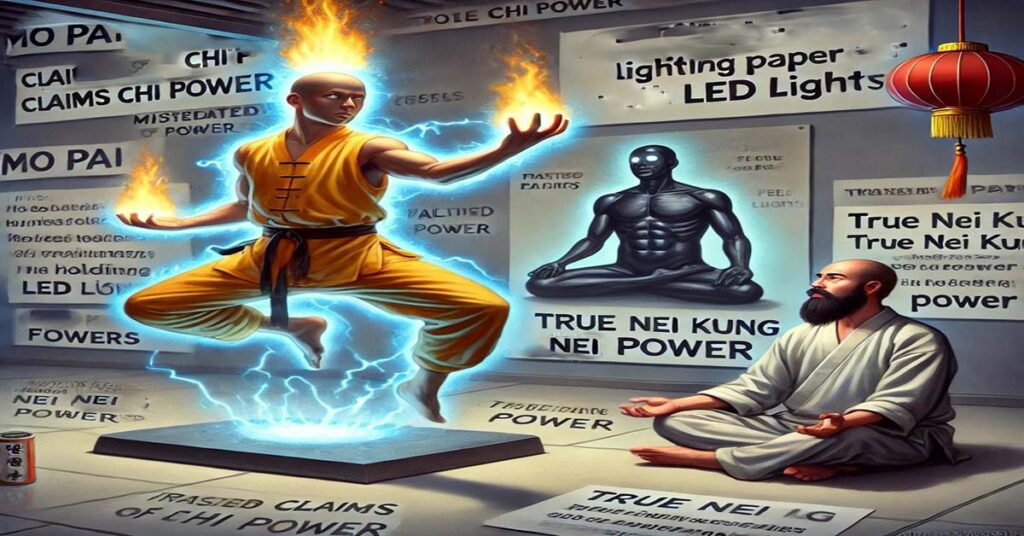
Master Gray emphasized that the version of Mo Pai practiced in the West had little to do with true chi kung. The story of Mo Pai’s introduction to Western audiences began when a group of tourists encountered John Chang, a man known for cultivating chi power for decades. The tourists were awestruck by his ability to demonstrate what seemed like supernatural powers: giving people electric shocks, lighting small LED lights, and even igniting paper.
However, Master Gray was quick to dismiss these so-called demonstrations of power. He pointed out that the ability to light up LED lights or ignite paper could easily be explained by common tricks and sleight of hand. “Anyone can buy LED lights that light up when held,” he would say. As for igniting paper, he explained that it was likely a chemical reaction, not some mystical chi energy at work.
The book Magus of Java further propagated myths about John Chang, claiming he was an immortal—a notion that Master Gray found laughable. “They made it up to sell books,” he would remark, dismissing the sensationalism around the story. For him, these inflated claims of immortality and supernatural powers were dangerous distractions from real chi kung practice.
The Problem with Western Mo Pai Students (WMPS)
One of the most troubling aspects of Mo Pai in the West, according to Master Gray, was how it was taught and disseminated. The students who studied under John Chang—Western Mo Pai Students, or as Master Gray wittily called them, “Wimps”—had learned only two techniques out of a purported 72-level system. These students, with minimal training and understanding, had no permission to teach yet proceeded to spread their incomplete knowledge, further distorting the practice.
Master Gray often highlighted the absurdity of teaching only two techniques over two years without offering corrections or further insights. “It’s a joke,” he would say, noting how even beginners could spot the glaring mistakes in these techniques. The limited understanding of Mo Pai led these “Wimps” to develop wild, incorrect theories about chi cultivation, leading to the creation of online forums where misinformation spread like wildfire.
Mo Pai is Not Nei Kung
One of Master Gray’s main criticisms of Mo Pai was that it was neither Taoist nor nei kung. Nei Kung, or internal alchemy, is a complex, holistic system involving thousands of techniques that focus on health, longevity, and spiritual cultivation. In contrast, Mo Pai as practiced by Westerners focused on just a few techniques, which were taught incorrectly and out of context. Master Gray explained that real nei kung systems work to develop the practitioner’s entire being—physically, emotionally, and spiritually—whereas Mo Pai’s narrow focus on a few tricks did nothing to advance one’s inner cultivation.
For Master Gray, the emphasis on physical demonstrations of chi power, such as giving electric shocks or lighting things on fire, was not only misleading but also harmful. True nei kung, he believed, was about developing subtle, internal power that worked in harmony with the body’s natural energy. The obsession with flashy displays of power was a sign of immaturity and misunderstanding.
The Absurdity of Grounding
One of the more comical aspects of Western Mo Pai, according to Master Gray, was the practice of grounding. The “Wimps” had taken the idea of sitting in full or half-lotus positions to ridiculous extremes. Some even advocated for sitting with a bare butt on a copper wire connected to the ground outside, believing this would enhance their chi cultivation. Master Gray found this idea utterly absurd and unscientific.
He would often explain that both the human body and the earth’s soil are insulators, not conductors. The idea that one could enhance chi power by sitting on the bare ground was not only laughable but also ignored basic facts about chi cultivation. “You can cultivate all the power you need by sitting in a chair indoors,” he would remind his students, emphasizing the importance of focusing on real nei kung practices rather than ridiculous, made-up rituals.
The Dangers of Tension in Mo Pai Practice
While Master Gray found much of Western Mo Pai amusing, he was deeply concerned about the potential harm caused by one of its core practices: the second exercise, which involved creating extreme tension in the body. This practice was supposedly designed to build chi power, but Master Gray knew better. He pointed out that tension in chi kung was unnatural and unhealthy.
Quoting Lao Tzu, Master Gray would often say, “Rigidity is the way of death; softness and flexibility are the way of life.” He explained that practices that create tension, like Mo Pai’s second exercise, were counterproductive to cultivating health and longevity. Such practices were more akin to Iron Shirt techniques, which are used for martial purposes rather than spiritual growth. “Most of them are going to die young,” he would say, echoing Lao Tzu’s warning about the dangers of rigidity.
The Cult-Like Nature of Western Mo Pai
Master Gray was also critical of the cult-like environment that had developed around Western Mo Pai. The small group of students who claimed to know the secrets of Mo Pai were led by a charismatic, egotistical leader who ruled over them like a dictator. This leader made grand claims about having access to secret knowledge, but Master Gray knew these claims were false.
The fact that these self-proclaimed Mo Pai practitioners had learned only two techniques (and likely incorrectly) was enough for Master Gray to dismiss them entirely. Yet, these “Wimps” continued to promote their practice, claiming they had discovered all 72 levels of the Mo Pai system.
“It’s all a lie,”
Master Gray would say, warning his students to steer clear of anyone who promised quick and easy results in nei kung.
Conclusion
Master Steve Gray’s insights into Western Mo Pai were clear and unapologetic. He believed that the Western version of Mo Pai was a complete distortion of real chi kung and nei kung practices, driven by ego, misinformation, and a desire for fame. He warned his students to avoid falling into the trap of seeking power for power’s sake and instead encouraged them to pursue the true path of internal cultivation.
For Master Gray, real nei kung was about softness, flexibility, and harmony with the natural flow of energy. It was not about flashy demonstrations or rigid practices that endangered one’s health. His teachings continue to serve as a guide for those seeking the real Way of chi kung, reminding us that the journey to inner power is one of humility, patience, and respect for the natural order of life.